A Powerful Mind by Adrienne M. Harrison
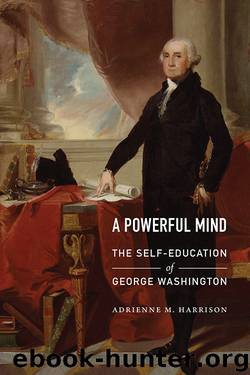
Author:Adrienne M. Harrison [Harrison, Adrienne M.]
Language: eng
Format: epub
Tags: BIO011000 Biography & Autobiography / Presidents & Heads Of State
ISBN: 9781612347899
Publisher: Potomac Books
Published: 2015-08-18T16:00:00+00:00
Washington and Ratification
During the various ratification conventions that followed, Washington began to collect the published writings that outlined both sides of the ratification debate. He obtained a copy of John Adams’s A Defense of the Constitutions of Government of the United States of America and Noah Webster’s An Examination into the Leading Principles of the Federal Constitution Proposed by the Late Convention Held at Philadelphia, with Answers to the Principal Objections that Have Been Raised against the System. Furthermore, Washington, who had always been an avid subscriber to newspapers and periodicals, began receiving copies of Noah Webster’s American Magazine: Containing a Miscellaneous Collection of Original and Other Valuable Essays in Prose and Verse, and Calculated Both for Instruction and Amusement and Mathew Carey’s The American Museum, or Repository of Ancient and Modern Fugitive Pieces and his The Columbian Magazine.46 These periodicals reprinted political essays from across the nation that centered on the Constitution. That Washington paid such close attention to how the ratification debates progressed is not surprising. First and foremost he believed that the Constitution was the way forward for the United States if it were to survive as a nation. He was sure that the strengths of the Constitution far outweighed its weaknesses. In his defense of the Constitution, Washington remarked that “the general Government is not invested with more Powers than are indispensably necessary to perform the functions of a good Government,” and as such, “no objections ought to be made against the quantity of Power delegated to it.” As the powers of the government were balanced between its respective branches, tyranny was impossible “so long as there shall remain any virtue in the body of the People.”47 Washington further believed that by granting the federal government the power over taxation and commerce, the new nation would be able to effectively defend itself, extend trade networks through formal concessions, protect rights to property, and encourage economic growth and prosperity.48 In Madison’s view, “no member of the Convention appeared to sign the instrument with more cordiality than he [Washington] did, nor to be more anxious for its ratification. I have indeed the most thorough conviction from the best evidence that he never wavered in the part he took in giving it his sanction and support.”49
One voice of dissent that Washington found potentially damaging was that of George Mason. Mason’s staunchly anti-federalist stance was hurtful to Washington, for the two men had been friends and neighbors for years, and Mason was a member of the Virginia delegation that was involved in all the meetings that produced the Virginia Plan. When the convention drew to a close, Mason not only refused to sign the Constitution but also published an essay condemning it as a frame of government with a paltry system of checks and balances. In Mason’s view the House of Representatives was too weak, the Senate was too powerful, and the Senate’s and the president’s responsibilities seemed oddly comingled. He also wanted three additional measures: a bill of rights
Download
This site does not store any files on its server. We only index and link to content provided by other sites. Please contact the content providers to delete copyright contents if any and email us, we'll remove relevant links or contents immediately.
Waking Up in Heaven: A True Story of Brokenness, Heaven, and Life Again by McVea Crystal & Tresniowski Alex(37764)
Empire of the Sikhs by Patwant Singh(23057)
We're Going to Need More Wine by Gabrielle Union(19020)
Hans Sturm: A Soldier's Odyssey on the Eastern Front by Gordon Williamson(18551)
Leonardo da Vinci by Walter Isaacson(13287)
The Radium Girls by Kate Moore(12001)
Tools of Titans by Timothy Ferriss(8346)
Educated by Tara Westover(8032)
How to Be a Bawse: A Guide to Conquering Life by Lilly Singh(7455)
Permanent Record by Edward Snowden(5807)
The Last Black Unicorn by Tiffany Haddish(5614)
The Rise and Fall of Senator Joe McCarthy by James Cross Giblin(5257)
Promise Me, Dad by Joe Biden(5127)
The Wind in My Hair by Masih Alinejad(5069)
A Higher Loyalty: Truth, Lies, and Leadership by James Comey(4937)
The Crown by Robert Lacey(4783)
The Iron Duke by The Iron Duke(4333)
Joan of Arc by Mary Gordon(4076)
Stalin by Stephen Kotkin(3937)
